
How to choose home healthcare providers in NYC and Westchester

TL;DR:
Finding the right home healthcare provider is stressful, requiring careful planning and ongoing engagement. Families should verify licenses, assess clinical and compassionate qualities, and monitor care carefully during the first month to ensure quality. Staying involved and acting promptly when issues arise leads to better outcomes and safer, more personalized care for loved ones.
Finding the right home healthcare provider for someone you love is one of the most stressful decisions a family can face. You might be sorting through dozens of agency names, unsure which ones are licensed, which ones truly care, and which ones will actually show up when needed. In New York City and Westchester, the number of options can feel overwhelming, and the stakes are real. A poor choice can mean inconsistent care, communication breakdowns, or even safety risks for your loved one. This guide walks you through every stage of the process, from gathering your needs before you call a single agency, to monitoring care quality once service begins.
Table of Contents
Key Takeaways
Point | Details |
Verify state license | Always check the New York State directory to ensure agencies are properly licensed. |
Use multi-factor evaluation | Combine public ratings, personal interviews, and scenario testing to choose the right provider. |
Assess both quality and compassion | Review clinical data and interview caregivers to evaluate professionalism and empathy. |
Monitor care closely | Regularly review service quality after care begins and speak up early if problems arise. |
What you need before starting your search
Before you compare agencies, take time to get organized. Families who skip this step often find themselves back at the beginning after signing contracts that don’t fit their situation. Start by writing down exactly what kind of help your loved one needs.
Documents and information to gather:
Medical records and a list of current diagnoses
A complete medication list, including dosages and schedules
Notes from any recent hospital discharge planner or social worker
Insurance cards (including Medicare, Medicaid, or private insurance details)
A written summary of daily routines, mobility limitations, and personal preferences
Contact information for the primary care physician and any specialists
Understanding the type of agency you need matters too. New York State licenses home care agencies under different categories. A Licensed Home Care Services Agency (LHCSA) provides personal care, housekeeping, and companionship. A Certified Home Health Agency (CHHA) offers skilled nursing and therapy services covered by Medicare or Medicaid. Knowing the difference helps you avoid calling agencies that simply cannot provide what your loved one needs.
You can verify licensed agencies through New York State’s official health directory before making any calls. This one step protects your family from unlicensed operators.
Agency type | Services offered | Typical funding source |
LHCSA | Personal care, companionship, ADLs | Private pay, Medicaid |
CHHA | Skilled nursing, therapy, wound care | Medicare, Medicaid |
CDPAP | Consumer-directed care with family aides | Medicaid |
Pro Tip: Include both family members and your loved one’s doctor in the initial planning conversation. A physician’s input can clarify whether skilled nursing is needed or whether personal care alone will be enough. For a broader look at planning home care in NYC, our guide walks through each step in plain terms.
Step-by-step guide to evaluating home healthcare providers
With your documents ready and your needs defined, you can move into structured evaluation. This stage is where most families either succeed or make costly mistakes by rushing.
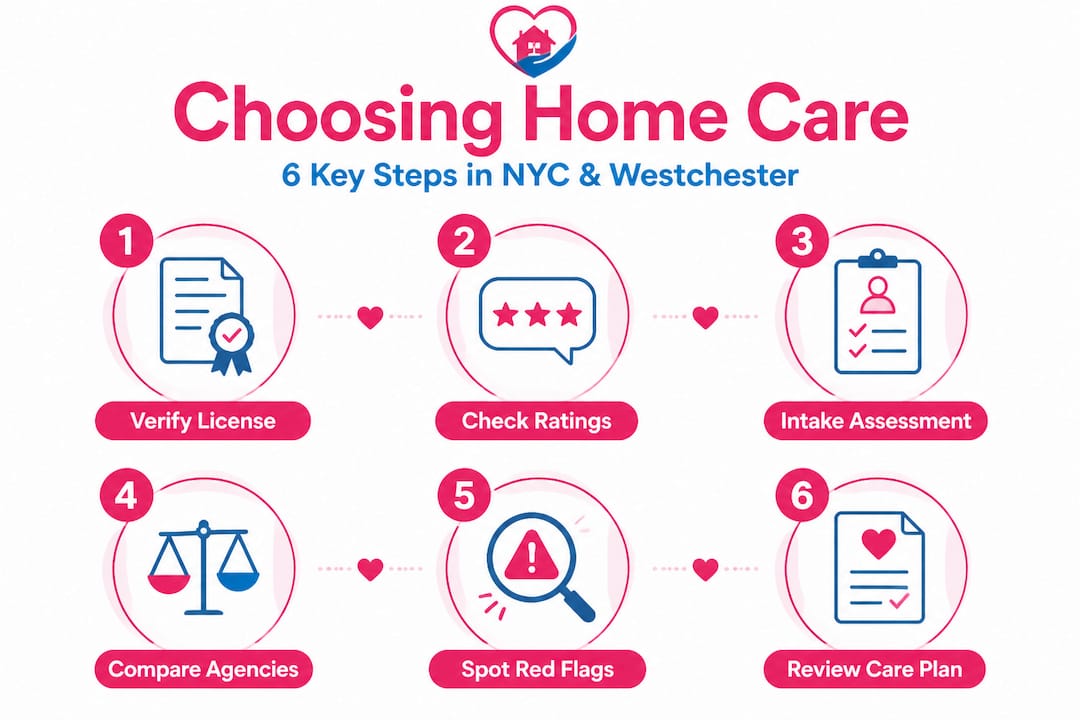
Step 1: Verify license and agency status. Use New York’s Profiles directory to confirm each agency’s license type and status. This takes about five minutes per agency and removes unqualified candidates immediately.
Step 2: Check CMS performance data. The Centers for Medicare and Medicaid Services (CMS) publishes quality ratings for home health agencies. Star ratings and report cards are useful, but they should not be the only factor in your decision. Some strong local agencies serve smaller populations and appear less prominently in national databases.
Step 3: Request a formal intake assessment. A reputable agency should offer a no-cost consultation where a care coordinator evaluates your loved one’s needs in person or by video. If an agency skips this and jumps straight to pricing, that is a warning sign.
Step 4: Compare agencies side by side. Use a comparison table during your calls to stay organized.
Evaluation factor | Agency A | Agency B | Agency C |
Licensed LHCSA or CHHA | Yes/No | Yes/No | Yes/No |
24/7 on-call support | Yes/No | Yes/No | Yes/No |
Multilingual aides available | Yes/No | Yes/No | Yes/No |
Staff turnover disclosed | Yes/No | Yes/No | Yes/No |
Care plan reviewed regularly | Yes/No | Yes/No | Yes/No |
Step 5: Watch for red flags. If an agency cannot clearly explain how it handles emergencies, refuses to provide references, or pressures you to sign quickly, step back. See our home care workflow steps for a detailed breakdown of what a well-run agency process looks like.
Step 6: Review the care plan in writing. Every service, schedule, and task should be documented before care begins. Vague agreements create problems later.
Pro Tip: Ask each agency for two references from current clients and two from former clients. Current clients tell you how things are going now. Former clients, especially those who switched away, tell you how the agency responds when problems arise. For more on transitioning to home care for the first time, we cover what to expect from the earliest stages.
Comparing clinical quality and compassionate care
Once you have narrowed your list, go deeper. Clinical quality and compassionate care are two separate things, and a strong agency needs both. One without the other creates a care experience that falls short.
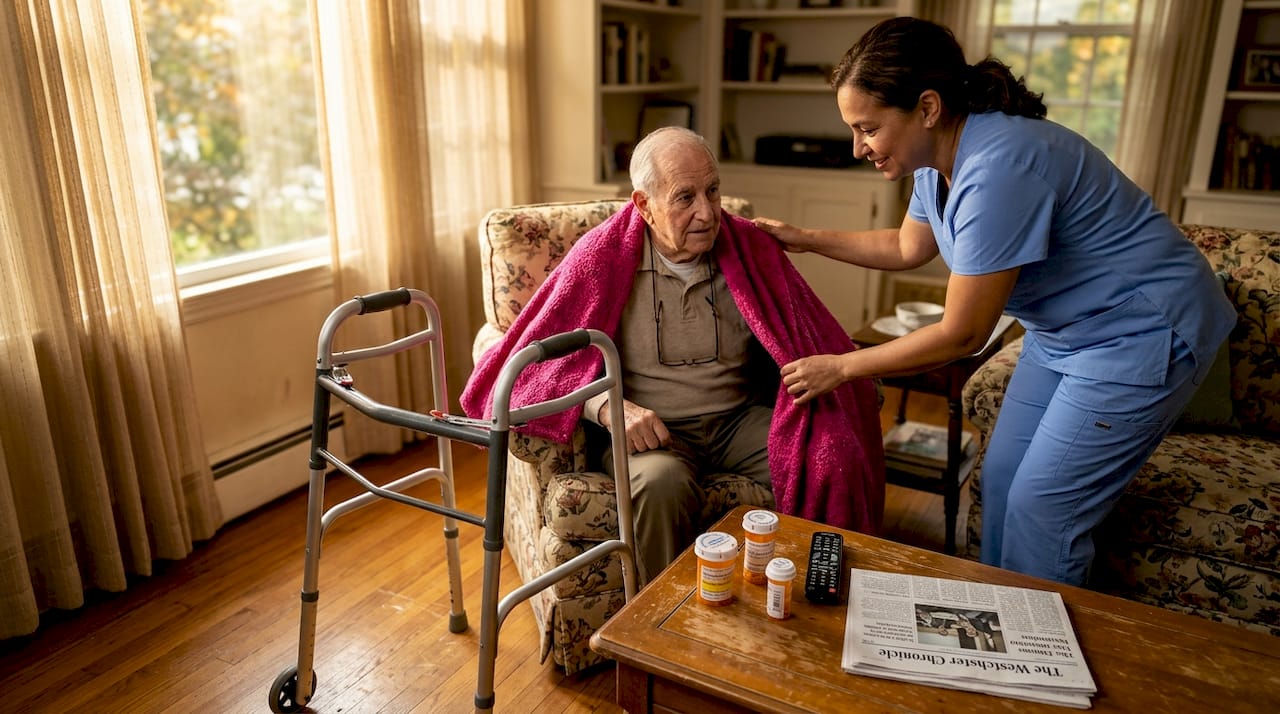
Clinical quality refers to measurable outcomes: medication management accuracy, fall prevention rates, wound care protocols, and coordination with physicians. These can be partially assessed through CMS data and state inspection records.
Compassionate care is harder to measure but just as important. It includes how aides communicate, whether they treat your loved one with dignity, and how quickly they respond when something feels off. No star rating captures this fully.
“A provider can have good bedside communication yet weaker clinical outcomes, and vice versa. Use multiple CMS components rather than a single star summary to build a complete picture.”
What to look for when evaluating compassion:
Does the care coordinator listen without rushing during your intake call?
Are aides described in terms of personality and communication skills, not just credentials?
Does the agency match aides to clients based on language, culture, or shared background?
How does the agency respond when a client or family member raises a concern?
Is there a consistent primary aide, or does the roster change frequently?
Staff turnover is one of the most telling indicators of agency culture. High turnover means your loved one will repeatedly face unfamiliar caregivers, which causes distress and increases safety risks. Ask each agency directly what their annual turnover rate is. A reluctance to answer is itself informative.
CMS star ratings and survey-based measures are only signals. Pair them with your own interviews and a review of the written care plan. For a fuller look at understanding home care quality as a family, we break down how to read quality indicators without getting lost in the data. You can also explore the family role in care evaluations to understand how involved you should expect to be.
Questions to ask and scenarios to evaluate
Scenario-based questions reveal how an agency actually operates, not just how they present themselves during a sales call. Any agency can sound polished. What matters is how they handle real situations.
Questions every family should ask:
How do your aides handle a client who refuses medication?
What happens if an aide calls out sick on a scheduled day?
How quickly does a supervisor respond to a family concern?
What is your protocol if a client falls while in the aide’s care?
How do you manage care when a client’s condition changes significantly?
“Ask how the home health team will manage meds, nursing needs, and escalation if your loved one’s condition changes after hospital discharge. This is one of the most important questions families skip.”
Families dealing with post-hospitalization needs face unique challenges. When a loved one comes home after a stroke, hip replacement, or cardiac event, care needs change fast. The agency you choose must demonstrate a clear process for adapting care plans quickly, coordinating with visiting nurses, and communicating updates to family members in real time.
A scenario worth testing: Tell the agency, “My mother just came home from the hospital and now needs help with medications, bathing, and physical therapy exercises. Her condition may still change. Walk me through what happens in the first 48 hours.” A confident, specific answer signals a well-prepared agency. A vague or generic response is a warning sign.
Pro Tip: During your interview, mention a difficult scenario such as a client with dementia who becomes agitated at night. Ask how the aide is trained to respond. The specificity and confidence of the answer tells you a lot about training quality and supervisor support. Our guide on NYC personal care services outlines what personal care aides are trained to handle.
How to monitor and adjust after care begins
Choosing a provider is not the finish line. The first month of service is critical, and your attention during this period can prevent small problems from becoming serious ones.
First-month monitoring checklist:
Visit or call your loved one at varied times to observe care directly
Review the aide’s daily log or communication notes after each visit
Ask your loved one how they feel about the aide’s communication and respect
Check that tasks outlined in the care plan are actually being completed
Confirm that medications are being given correctly and on time
Schedule a 30-day check-in call with the care coordinator
Red flags to watch for after care begins:
Your loved one seems fearful, withdrawn, or unusually quiet around the aide
Medication errors or missed doses
Tasks listed in the care plan are skipped without explanation
The agency is slow to respond to calls or messages
Aide substitutions happen frequently with no advance notice
Star ratings and agency reports should be paired with your real experiences from day one. If the agency’s ratings looked good but daily reality does not match, trust your observations. For more on maintaining quality long term, our resource on home care and senior wellness covers how consistent, quality care supports your loved one’s overall health.
If problems persist after you raise them formally with the agency, switching providers is a reasonable and sometimes necessary choice. Document your concerns in writing, give the agency a clear timeline to resolve them, and be prepared to act if they do not follow through.
Why most families overlook the warning signs and what really matters
We have worked with hundreds of families across Brooklyn, Queens, the Bronx, Manhattan, Staten Island, and Westchester. Here is what we have learned: the families who get the best outcomes are not necessarily the ones who researched the most before choosing. They are the ones who stayed engaged after care began.
Most families put enormous effort into the selection process, then step back once an aide is placed. That shift is completely understandable. You are relieved. You are tired. But it is also the moment when small problems start to grow unnoticed.
The families who act quickly when something feels off, who call the agency without hesitation when a task is missed, who check in with their loved one directly instead of just relying on the caregiver’s reports, those families consistently report better care experiences. Not because they were lucky, but because their involvement created accountability.
Soft skills matter more than most families expect. An aide with strong empathy and communication can often prevent a fall or medication error through relationship alone. They notice when a client is having an off day. They ask the right questions. Credentials matter, yes. But the human connection between a caregiver and a client is what turns adequate care into genuinely good care.
We also want to be honest about something: even the best agencies have difficult days. What separates good agencies from poor ones is not perfection. It is how they respond when things go wrong. That responsiveness is what you are evaluating, from your first call through the entire care relationship.
Learning about the benefits of in-home care can also help families feel more confident in their decision to pursue home-based support rather than facility-based alternatives.
Find trusted home healthcare for your family
Now that you have a clear framework for evaluating and monitoring home healthcare providers, the next step is finding a partner you can trust. At Friendly Home Care, we are fully licensed by the New York State Department of Health and accredited by The Joint Commission. We serve families across all five boroughs and Westchester County with personalized, compassionate care plans built around each client’s specific needs.
We offer multilingual aides, 24/7 family support, and a transparent care planning process that keeps you informed at every step. Whether you need short-term post-hospital support or long-term daily assistance, our team is ready to help. Explore our personalized senior care options or schedule a consultation today. We are here to make this process as clear and reassuring as possible for your family.
Frequently asked questions
How can I confirm if a home care agency is licensed in New York?
Use the NY State health directory to search for any agency and verify its license type and current status. This is free, takes only a few minutes, and is the safest first step before making any calls.
Do CMS star ratings reflect real home care quality?
CMS ratings are useful signals but should always be combined with your own interviews, care plan reviews, and direct observations. No single rating captures the full picture of daily care quality.
What should I ask when interviewing a home healthcare provider?
Ask about staff training and escalation scenarios including how they handle medication refusal, sudden condition changes, and emergency response. Specific, confident answers indicate a well-prepared and accountable agency.
What should I do if care quality declines after starting service?
Raise concerns early and document them in writing with the agency, then monitor for improvement. If the issues continue without resolution, switching to a different provider is appropriate and in your loved one’s best interest.
Recommended